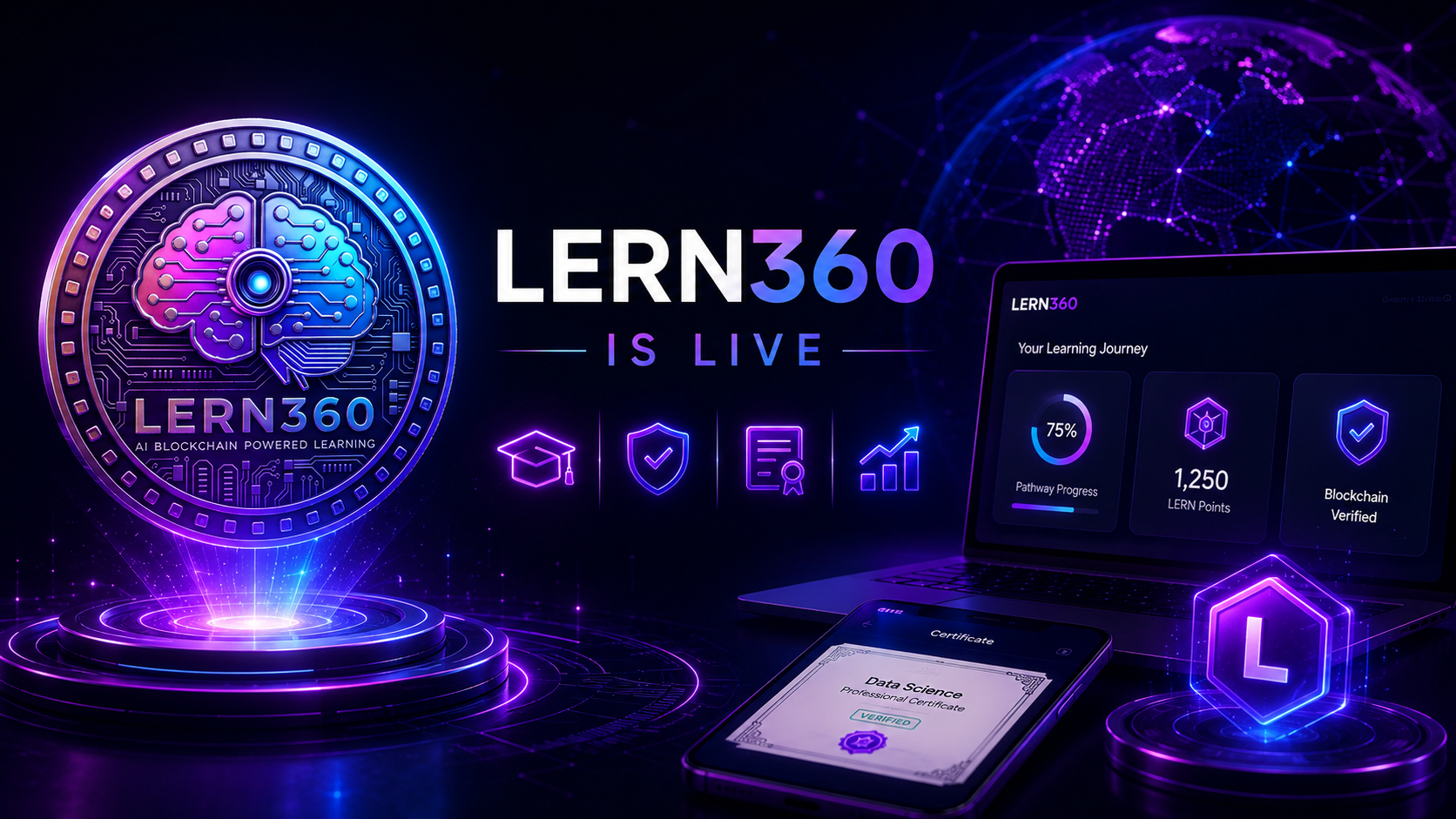
On June 30, 2026, LERN360 entered a new phase. The project is no longer only a vision for how education, credentials and Web3 can work together. It is now a live learning infrastructure that users can access through lern360.ai, explore directly and begin using as part of their own professional development.
That shift matters because the strongest technology brands are rarely defined by a long list of separate features. They are defined by the role they perform in people’s lives. LERN360’s role is becoming increasingly clear: it is building the infrastructure that connects learning access, AI-guided pathways, verified credentials, career tools and token-based participation inside one ecosystem. In practical terms, it gives users a place to learn, prove what they have learned and connect that progress with future growth.
For a new user, the experience does not need to begin with blockchain terminology or complicated product architecture. The first interaction is much more direct. A learner can arrive at LERN360, create an account, explore a large course marketplace, search by interest, generate an AI-powered learning pathway, store credentials in the LERN Wallet and begin building a learning identity that is not limited to one course, one provider or one moment in life.
This is why LERN360 should not be described too narrowly. It is not only a course website, even though courses are central to the experience. It is not only a wallet, even though the LERN Wallet is one of its most important components. It is not only an AI tool, even though AI Learning Pathways help users turn goals into structured routes. It is not only a certificate system, even though verified credentials are part of the platform’s value. It is not only a token project, even though $LERN plays a clear role in access. Each of these descriptions is partly true, but none of them is complete. The larger idea is that LERN360 is building the infrastructure around continuous learning.
The first part of that infrastructure is access. Through the LERN360 Courses Marketplace, users can explore more than 55,000 curated courses across professional disciplines including artificial intelligence, data, technology, business, finance, marketing, cybersecurity, Web3, cloud, leadership and design. The catalogue includes learning opportunities from names that already carry weight in global education and professional training, including Google, IBM, Microsoft, Harvard, Stanford and DeepLearning.AI.
This matters because modern learners rarely build their skills through one institution or one provider. A professional may take a Google certificate, study a Microsoft course, explore AI through DeepLearning.AI, complete a university-backed business module and later add a course in cybersecurity, finance or marketing. That is already how career development works. People move across providers, platforms, formats and goals. LERN360 is being built around that reality rather than pretending learning still follows one fixed path.
The value of LERN360 is not simply that courses exist. The internet already has more educational content than any person can consume. The value is that LERN360 gives the learner one access point into a broader environment where course discovery is connected to guidance, credentials, ownership, market context and opportunity. Instead of treating every course as a separate event, the ecosystem helps users connect learning decisions into a longer professional record.
This is where the stake-to-access model becomes important. LERN360 should not be understood as a traditional course subscription, and it should not be explained as “buying tokens to take courses.” That framing makes the product sound smaller than it is. The clearer explanation is that staking $LERN unlocks access to the LERN360 infrastructure for the duration of the vault period. The token has a specific role: it is the access mechanism. The learner stakes once, activates the ecosystem and enters an environment built around learning, proof and career growth.
This distinction is important because many Web3 projects lead with the token and only later try to explain the product. LERN360’s stronger narrative works in the opposite direction. A user first understands what the ecosystem gives them: access to a curated course marketplace, AI-powered pathways, a wallet for credentials, tools to understand market value and a connection between verified skills and opportunities. Once that value is clear, the token model becomes easier to understand. Stake equals access.
For many learners, the first practical need is course discovery. Some users arrive knowing exactly what they want. They may be looking for an AI course, a cybersecurity module, a data analytics pathway, a finance class, a cloud computing course or a marketing certificate. For them, search is the natural starting point. They can browse the marketplace, compare options and begin exploring without needing to understand every part of the ecosystem immediately.
Other users arrive with a broader goal rather than a precise course title. They may want to move into AI, improve their digital skills, prepare for a promotion, change career direction, strengthen their CV or understand which skills could help them earn more. For these users, a long list of courses can be helpful, but it can also be overwhelming. This is where AI Learning Pathways become central to the LERN360 experience.
The pathway system helps users move from a general goal to a more structured route. Instead of leaving a learner with disconnected course options, the AI can help identify a direction, organise relevant modules and connect the user with course options drawn from the real catalogue. A person who wants to “learn AI,” for example, may need a very different pathway depending on their background. A marketer may need AI for content workflows, automation and analytics. A finance professional may need AI for reporting, modelling and decision support. A founder may need AI for operations, research and productivity. A developer may need a more technical route. The phrase may be the same, but the learning journey should not be.
This is where LERN360’s infrastructure logic becomes visible. Search helps a learner find what is available, but a pathway helps the learner understand what to do next. The platform does not remove choice; it gives choice more structure. That structure is especially useful for people who want their learning to lead somewhere concrete, whether that means a stronger career profile, a new professional direction or a clearer understanding of their own skill gaps.
The second major part of the LERN360 ecosystem is proof. Learning becomes more valuable when the learner can keep, organise and share evidence of what they have completed. This is the role of the LERN Wallet. Most people already understand the problem it solves. A certificate from one provider sits in an email. Another is stored as a PDF. Another lives inside a course dashboard. Another came from an employer training session. Another might be a university, Google or Microsoft credential. Each achievement may matter, but together they rarely form one clean professional record.
The LERN Wallet is designed to become the learner’s identity layer inside the ecosystem. It gives users a place to store credentials, achievements, staking status and career profile in one environment. The idea is not simply to collect certificates. The idea is to give learning a permanent, portable and verifiable home.
This is important because careers are becoming less linear. A degree earned years ago may still matter, but it no longer tells the full story of a person’s current skills. Professionals build credibility over time through courses, certificates, workplace training, self-directed learning and new tools. They may move between industries, return to learning after years of work or build new capabilities while already employed. Their learning record has to be able to grow with them.
The LERN Wallet supports that by giving users a place to organise their achievements and make them easier to share. A learner should not have to search through old emails or platform dashboards every time they want to prove what they have done. Their learning identity should be accessible, owned and ready to use when they need it, whether they are applying for a role, preparing for a promotion, building a professional profile or showing progress to a client or employer.
Verification is the next part of the proof layer. A certificate should be more than a file. It should be something that can be checked, trusted and carried forward. This is where blockchain has a practical role inside LERN360. The purpose is not to make the learner think about technical infrastructure every time they complete a course. The purpose is to make credentials more durable, more portable and harder to manipulate.
In a skills-first job market, proof matters. Employers, clients, institutions and collaborators increasingly want to understand what people can actually do. A resume line may help, but a verified credential record can say more. It can show that a learner has completed specific training, stored the result and made it part of a broader professional profile. LERN360’s credential layer is designed to support that kind of record, where learning does not disappear after a course ends.
The platform also gives achievement a public dimension. Credentials can support public profiles, social sharing and AI-generated captions for LinkedIn or WhatsApp. This matters because learning should not be invisible. When someone earns a certificate, that moment can support a career pivot, strengthen a CV, signal professional momentum or help the learner communicate progress to their network. LERN360 turns achievement into something that can be stored, shared and used.
The third part of the ecosystem is growth. LERN360 is not only about accessing courses and storing credentials. It also connects learning with career direction through tools such as LernMyWorth and LERN Jobs. LernMyWorth is designed to help users understand the estimated market value of their skills and credentials. This should be understood carefully, because no serious platform should promise a salary outcome. Its value is in giving learners context. It can help them see where their profile may be strong, where skill gaps may exist and which learning steps could help them move closer to the roles or opportunities they want.
For example, someone who wants to move into data analytics may discover that beginner-level certificates are a starting point, but that SQL, Python, visualisation or project-based experience could strengthen the profile further. A marketer may see that AI tools, analytics or paid media skills could make their background more competitive. A finance professional may realise that data interpretation or automation skills are becoming increasingly relevant. The point is not to give a final answer about a person’s career. The point is to give them a clearer view of where learning can create value.
LERN Jobs extends that same direction by connecting verified skills with opportunities. Again, the value should not be framed as a guarantee of employment. It is a way to make the learning record more useful. If a user has completed courses, stored credentials and built a stronger profile, the next step is to understand which opportunities may match that verified skill base. LERN360 is building toward that connection between learning, proof and work.
This is how the ecosystem comes together. Access gives the learner a way into the course marketplace. Proof gives them a way to own and verify what they complete. Growth tools help them connect that progress with market value, career visibility and opportunity. The simple idea behind the model is that one stake gives the user access to what they need to learn, prove and grow.
That is why the launch of the full site matters. Before LERN360 went live, the project had to be understood largely through vision, strategy and future potential. Now the story is more concrete. Users can explore the course marketplace, generate pathways, activate access through staking, store credentials, build a learning identity and use career tools that make the learning record more useful over time.
This does not mean learning becomes effortless. LERN360 does not remove the work. A learner still has to choose a direction, complete courses, build skills, earn credentials and apply that knowledge in the real world. The value of the ecosystem is not that it does the learning for them. The value is that it gives the journey more structure, proof and continuity.
Many education products focus on the moment of consumption. A user enrols, watches, completes, downloads a certificate and moves on. LERN360 is being built around what happens before, during and after that moment. Before the course, the learner needs access and direction. During the course, they need a route they can follow. After the course, they need proof, a place to store it and a way to use it professionally.
This is what makes LERN360 closer to infrastructure than a normal course website. Infrastructure connects systems. It allows different parts of a market to work together. It does not need to replace every participant in order to create value. LERN360 does not need to be described as only a course provider, only a wallet or only an AI recommendation tool. Its role is to connect those parts into one learning ecosystem that supports the user over time.
That role is becoming more relevant as people are expected to keep learning throughout their lives. Students need early proof of skills. Job seekers need stronger career profiles. Professionals need to stay current. Career changers need structured routes into new fields. Web3 users need credential systems that match the ownership logic they already understand. Employers need clearer signals of what people can actually do.
LERN360 sits at the intersection of those needs. Its strongest audience is not only people who want another online course. It is career-driven learners who understand that skills, credentials and ownership are becoming more important. Many already understand wallets, tokens and staking. Others may come from the traditional learning market and feel frustrated by fragmented courses, recurring subscriptions and credentials that do not travel well. LERN360 connects these worlds through one access model and one learning identity.
That is why the language around the project matters. LERN360 should not be reduced to “buy a token,” “browse courses” or “store certificates.” The stronger story is more complete: stake once, access the infrastructure, learn through curated courses, prove progress through verified credentials and use career tools to grow.
The June 30 launch marks the moment when LERN360 begins moving from explanation to experience. The infrastructure is now live, and users can see how its core parts work together: course access, AI-guided pathways, the LERN Wallet, verified credentials, market-value insight and career tools. The result is not another isolated course website and not another token story. It is a learning infrastructure designed to make continuous learning easier to access, easier to prove and easier to use.
lern360.ai
Sponsor This Article Area
Show your project to readers already engaged with crypto news and market content.