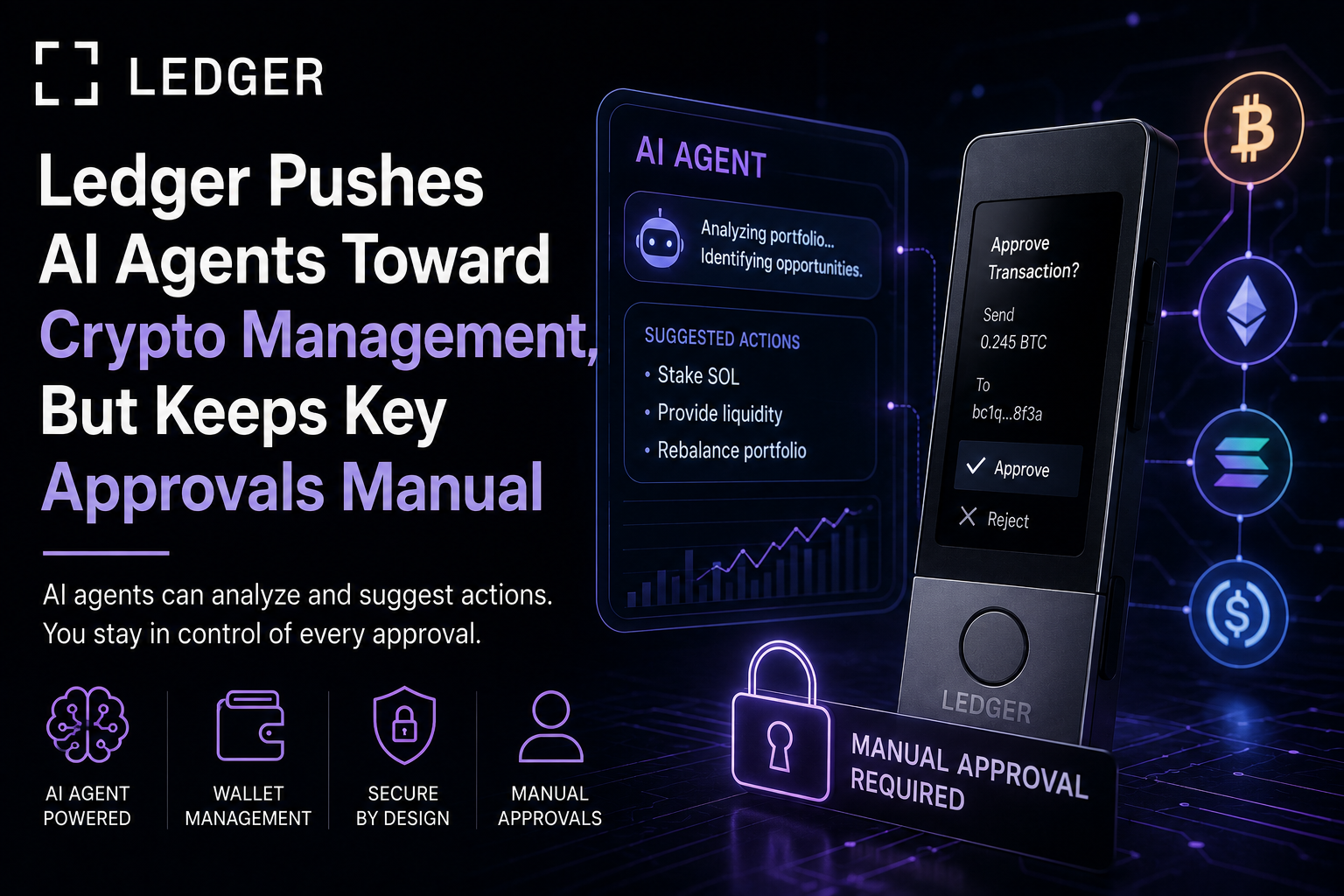
Ledger is outlining a model for letting AI agents assist with crypto management without giving them direct control of private keys, according to CoinDesk. The hardware wallet maker’s approach is aimed at preserving the security boundary that has long defined self-custody: agents may be able to read balances and review portfolios, but they would not be allowed to complete sensitive actions on their own.
Instead, any transaction or other high-risk step would require explicit approval on a Ledger device before it can be executed. That design keeps the user, rather than the software agent, as the final authorization point. The idea is likely to appeal to users interested in automation, while still remaining cautious about handing asset control to a system that can make mistakes or be manipulated.
The proposal sits at the intersection of two fast-moving crypto themes: AI agents and wallet security. AI tools are increasingly being positioned as assistants for monitoring accounts, summarizing holdings and helping users track activity across markets. But in crypto, convenience often collides with custody risk. A model that can inspect wallet balances but not move funds without hardware confirmation reflects that tradeoff.
Ledger’s framing suggests it is trying to capture some of the practical benefits of AI without weakening the core security model of a hardware wallet. That distinction matters because crypto users are often wary of allowing third-party systems, including automated agents, to sign transactions or access keys directly. The company’s structure appears designed to keep sensitive permissions off the agent entirely.
The details available are limited, and it is not clear from the source metadata how broadly the feature would be deployed or when it might be available. Still, the concept underscores a broader industry question: how to integrate automation into crypto workflows without turning custody over to opaque software.
For now, Ledger’s approach seems to preserve a familiar rule. AI can assist with analysis and monitoring, but it stops short of acting as an independent custodian. In a market where security failures can be costly and irreversible, that constraint may be the point.