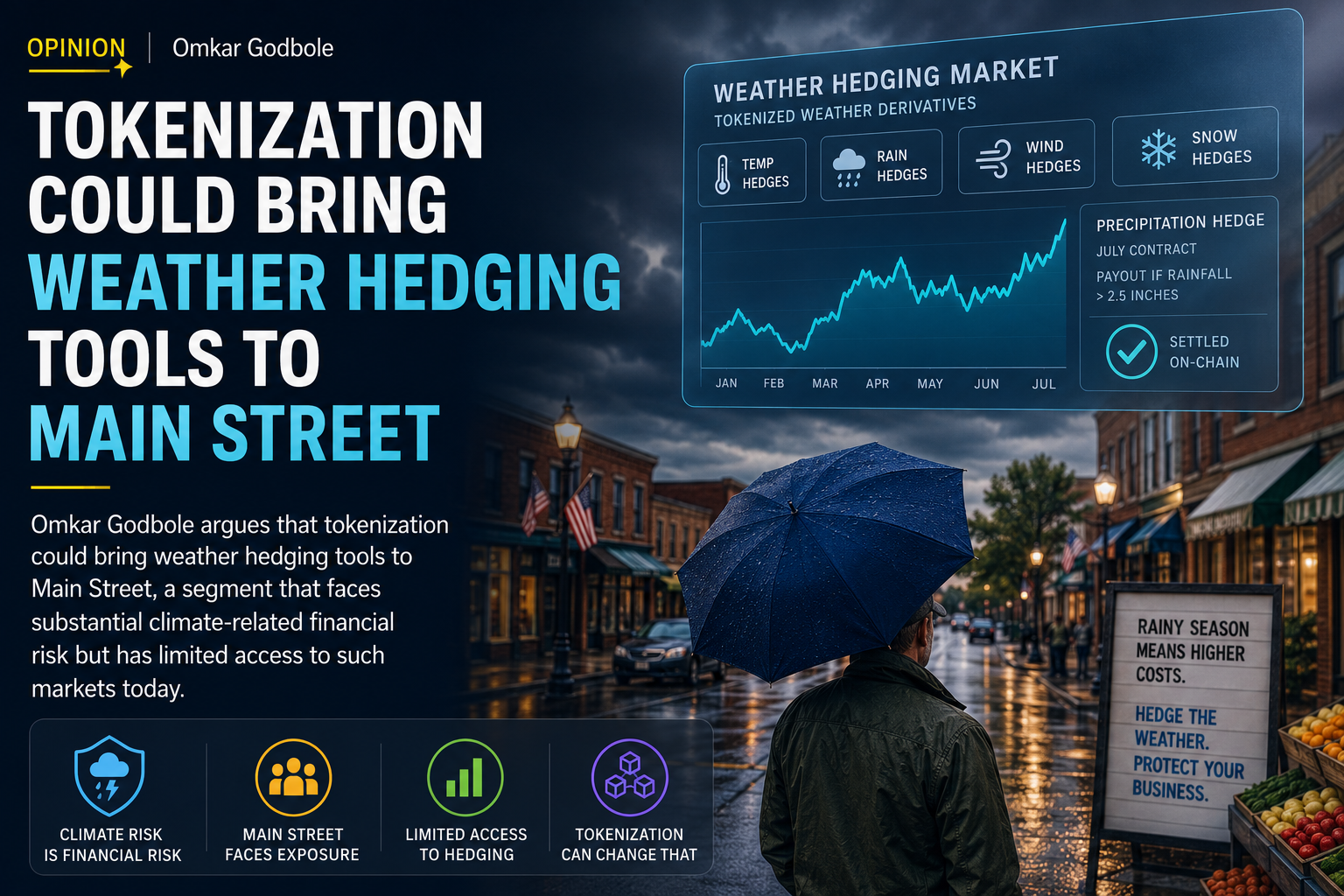
Tokenization could make weather derivatives more accessible to ordinary businesses and households that face climate-related financial risk, according to CoinDesk’s Omkar Godbole. The argument is straightforward: while weather can disrupt revenue, supply chains and operating costs, the market for hedging that risk has historically been difficult for Main Street participants to access.
That gap matters because weather exposure is not limited to large institutions. Small businesses, farms and other local operators can be hit by sudden shifts in temperature, rainfall or other conditions that affect day-to-day cash flow. Yet the tools used to hedge those risks have typically sat in specialized financial markets, out of reach for many smaller participants. Godbole’s view is that tokenization may provide a path to broader access.
The idea fits a wider trend in crypto, where tokenization is increasingly framed as a way to package real-world assets and contracts into more portable digital forms. In this case, the asset is not a stock or bond, but a derivative tied to weather outcomes. The core appeal is practical rather than speculative: if the structure can be simplified and distributed more widely, it could help users transfer climate-related risk instead of merely absorbing it.
Still, the market is likely to remain niche relative to mainstream crypto trading and established derivatives markets. Weather products are inherently complex, and their usefulness depends on how well they match a user’s actual exposure. There is also a difference between concept and adoption. Even if tokenization improves access, any such market would still need clear rules, reliable settlement mechanisms and enough liquidity to function smoothly.
Godbole’s broader point is that the most important real-world application of crypto may not be payments or trading, but infrastructure that helps people manage everyday risks. In that framing, weather derivatives are compelling because they speak directly to climate-related financial stress, an issue that is becoming more visible while tools for smaller users remain limited.
For now, the proposal should be viewed as a market idea rather than a developed product category. But it highlights a direction in which blockchain-based finance is trying to move: from abstract digital assets toward instruments that address concrete economic problems. Whether tokenized weather hedges can scale beyond a specialized audience remains uncertain, but the underlying need is clear.